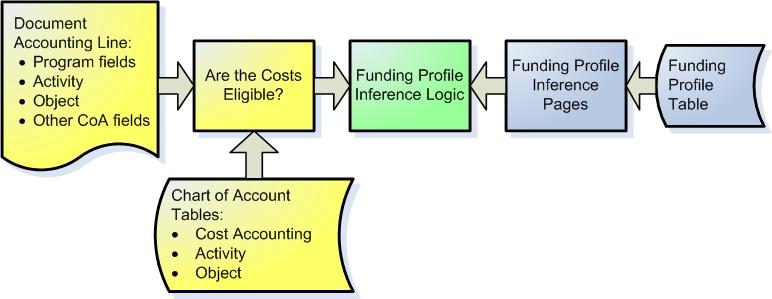
The following diagram provides a pictorial high level overview of the process to infer funding profiles and determine eligibility.
As mentioned above, there are multiple COA tables that work with the funding profile inference tables to determine reimbursement eligibility: Program (PROG), Program Phase (PHPRG), Activity (ACTV), Object (OBJ), and Funding Profile (FPRFLST) tables.
Each of these has a Reimbursement Eligible flag that will determine if a code on that table is 'Eligible' or 'Ineligible'. If any of these tables is Ineligible for a code used on an accounting line, then no funding profile will be inferred for a Front End Split Major Program, unless the matching inference table overrides that setting to Eligible. For a Back End Split Major Program the same is true when Reimbursement Selection creates the Charge document. The need for the override ability on a funding inference table by Phase, Program, Activity, or Object will determine which inference table is used.
An eligible or ineligible Funding Profile is appropriately determined during document processing based on the evaluation of the Eligible for Reimbursable indicator on the Program, Program/Phase, Activity, Object and exception tables. For example, during a preliminary design phase of a project, an activity such as drafting preliminary designs can be considered an ineligible inactivity. Based on the final determination of the Eligible for Reimbursement indicator, the Funding Profile code is inferred based on the inference table setup. For example, you can setup the inference tables such that an enhanced Funding Profile is inferred for your Food Stamps fraud related program and a standard Funding Profile is inferred for your food stamp issuance program. In this example, the Federal government can reimburse 90% of eligible expenditures within the agreements of the enhanced Funding Profile, but only reimburse 50% of eligible expenditures in the standard profile.