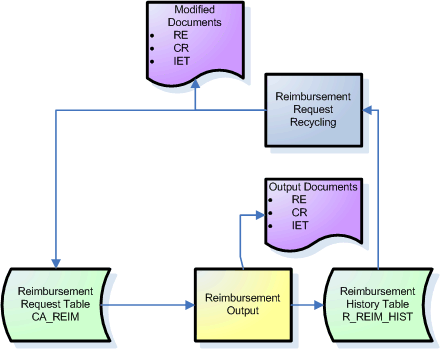
The Reimbursement Request Recycling process is run when a portion of a reimbursement request has been denied. Some reasons a reimbursement request may be denied are for insufficient available funding, or because the terms of the request are invalid (incorrect CMIA number or Letter of Credit). The records related to the denied portion of a prior reimbursement request will be identified by terms retrieved by the specification of a Reimbursement Request Recycling (RECYCLE) parameter record ID into the chain job. That parameter ID will also specify the job ID of the original reimbursement request with the denied records. Department and Program or Appropriation are used to identify specific records in the original request that were denied. After the Reimbursement Request Recycling process is run, the reimbursement records should be placed on hold until corrective actions are made in the cost accounting area. The records will be available for inclusion in a subsequent reimbursement request if not placed on hold, or when the hold is removed.
This process is a chain job consisting of 7 chains.
Reimbursement Recycle Request Process.
SysmanUtil for uploading RE Documents from XML.
SysmanUtil for uploading CR Documents from XML.
SysmanUtil for uploading IET Documents from XML.
SysmanUtil for submitting CR Documents
SysmanUtil for submitting RE Documents
SysmanUtil for submitting IET Documents
The Reimbursement Recycle Request Process retrieves records from the Reimbursement History (R_REIM_HIST) table based on a RECYCLE parameter. These retrieved records are then processed, and modified Cash Receipt, Receivable and Internal Exchange Transaction XML files are created based on the Reimbursement Output Type (attribute REIM_OTPT_FRT) of the Funding Line values selected. If the value is 1 then the process generates modification XML for Receivable documents, if the format is 2 then the process generates modification XML for both Cash Receipt and Receivable documents, if the format is 3 or 4 then the process generates modification XML for Internal Exchange Transaction documents. The process also updates the Recycle Request Temporary (R_RCYC_REQ_TMP) table with all the records it processed. In case of any discrepancy while generating the XML, the process logs the error message on the corresponding record on the Recycle Request Temporary (R_RCYC_REQ_TMP) table. After the data processing is over, the process then generates reports based on the Recycle Request Temporary table. After the report generation process performs table updates on the basis of Reimbursement Request Temporary to back out the Reimbursement History table and to move data into the Ready for Reimbursement table so that the data is available for subsequent recycle process.
Thus, the selected records included in a reimbursement request will be backed out of the Reimbursement History table and from receivable transactions, and placed on the Ready for Reimbursement table. They will then be available for inclusion on a subsequent reimbursement request.
Additional jobs included in the chain will be steps using SysManUtil to load and process XML files created by the Reimbursement Request Recycling process.